PRODUCT ENGINEERING COMPANY
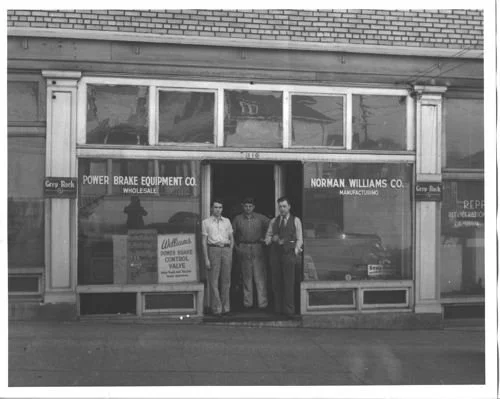
Left to right: Ralph McGilvra, Jim Montgomery and Norman Williams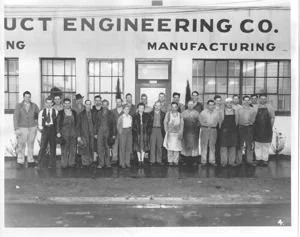
PECO employees, 1940s or 1950s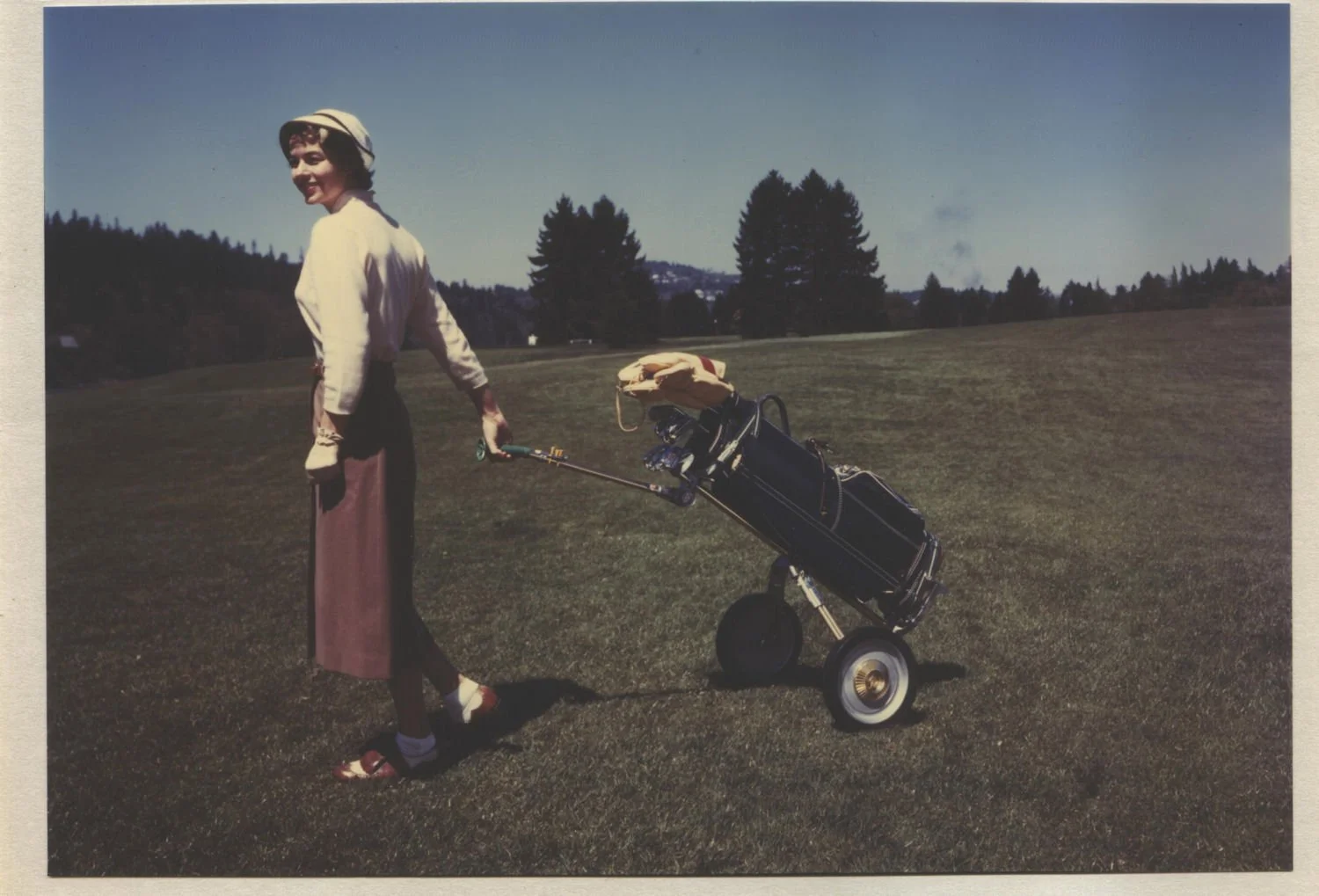
Con-voy Golf Cart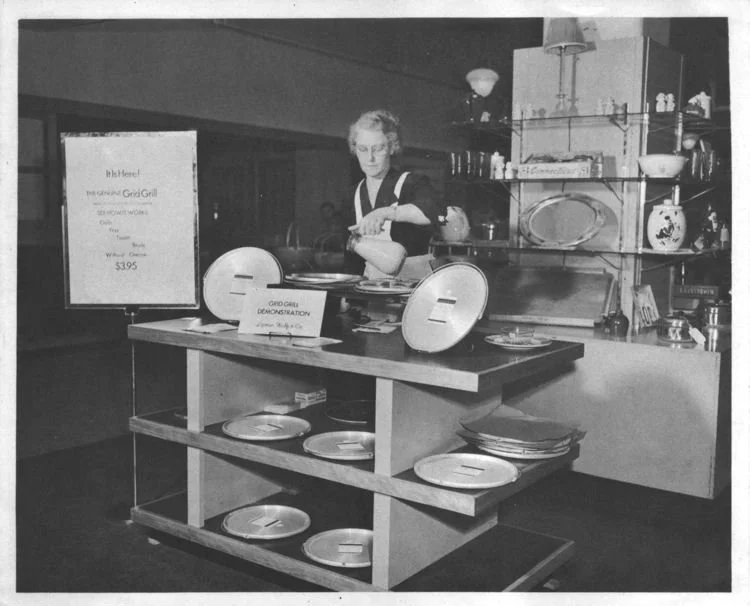
Grid-GrillProduct Engineering Company (PECO) was founded in 1939 by Mr. Ralph D. McGilvra. The production facility was located at 4707 S.E. 17th Avenue, Portland, Oregon. It was a pioneer in die casting, and was the largest and oldest firm in the Pacific Northwest.
While he worked at Iron Fireman in Portland, the owner of Williams Brakes, Norman Williams, approached Mr. McGilvra about casting brake parts. They successfully collaborated to cast brake parts, and Mr. Williams asked Mr. McGilvra to continue the partnership. But Mr. McGilvra wanted to own his own firm, and in 1939 he formed Product Engineering Company (PECO).
During World War II, Product Engineering manufactured fuse shell parts for Army Ordnance, aircraft electrical fittings, and electrical fittings for The Maritime Commission.
After the war, Product Engineering expanded considerably and became a custom job shop for those with product ideas. PECO produced furniture hardware and handles, builders hardware, thermostatic controls, fire extinguishers, various toys, parts for recording instruments, precision sextant parts, aircraft castings, Con-Voy golf carts, postman delivery carts for both the United States and the Dutch governments, aluminum hem-measuring gauges for home dressmakers, marine hardware, and radiation measuring identification cards. However, the biggest successes came from products marketed nationally - air brake control valves, lawn sprinklers, toy cap guns and floor polishers marketed under the Beal Speed Polisher brand.
Product Engineering made several toys, including Sturdi-Bilt toy trucks (1949), a Frontier Smoker cap gun (1950), and plastic toy soldiers (1954).
On August 6, 1950 a fire completely destroyed the building, turning it into a six foot high pile of rubble. The building was valued at $150,000, and fifty people were employed. Mr. McGilvra displayed tremendous tenacity and, against the counsel of many, had equipment operating in 10 days under a tin roof. Customers, employees, suppliers and even competitors came to his aid, and he ran production from five different locations around Portland until a new structure was built.
Mr. McGilvra died in 1962, and in July 1963 Northwest Industries Inc. (NWI) acquired PECO. Northwest Industries, located in Albany, Oregon did precision machining and fabrication of refractory, reactive- and corrosive-resistant metals for the pulp and paper, chemical and aerospace industries.
At the time of purchase, PECO had 24,000 square feet of production space, 6 die-casting machines, 3 injection molding machines, and a tool and die shop. PECO had revenues of over $1,000,000 and 75 employees. Paul C. Diegel was the general manager, and Clyde Rushing was the executive vice president for the combined operations. The owner of NWI was Mr. Charles K. McCormack, the former mayor of Albany, President of Delta Land Company, and the insurance company of Beam, McCormack and Atwood. Besides its own products, PECO manufactured and distributed Convoy golf and mail carts and Sea Dart marine hardware.
In March, 1966 Mr. McCormack orchestrated the merger of PECO with three other businesses -- North Albany Land Company, Delta Land and Investment Company and Delta Improvement Corporation -- and formed Northwest Intermountain Development Company (NWIDC). At that time, documents indicate PECO "engages in custom die-casting and plastic molding, and manufactures a line of mail carts, golf carts and accessories, and other products". At the time of the merger, Mr. Clyde Rushing was executive vice president of finance for NWIDC and also president of PECO.
In 1967, PECO was purchased by Dean Schamp, Clyde Rushing, A.W. Michaelis, and Ed Halberg. The firm grew strongly through the late 1960s adding injection molding services and aerospace products to its core capabilities.
In 1972, Sunne Controls became an integral part of PECO, offering temperature controls to the commercial cooking, agricultural and HVAC markets. It was renamed PECO Manufacturing.